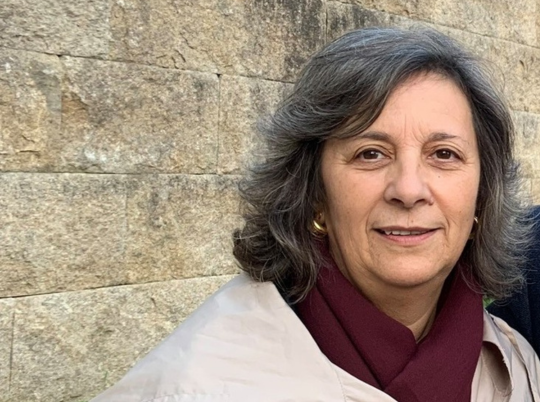
Fernanda Ribeiro
Faculty of Arts and Humanities of the University of Porto (FLUP) / Transdisciplinary Research Centre Culture, Space and Memory (CITCEM)
Research Activity in Information Science
Research Activity in Information Science
Your academic and scientific trajectory spans areas such as Information Science, Archival Studies and History. Which moments or experiences were decisive in shaping this interdisciplinary path?
I hold a degree in History (1980) and earned the Librarian-Archivist diploma at the Faculty of Arts of the University of Coimbra (1982). Until 1983, this postgraduate-level course was the only training in Portugal for those who wished to work in libraries and/or archives, and was a mandatory requirement to enter the senior technician career in public archives or libraries. My interest in this field began during the 1975–76 academic year, when I served in the Student Civic Service (the year before I started at university) at Braga Public Library. In fact, I chose to study History precisely because it was the most suitable background for later entering the Librarian‑Archivist Course, although this basic training did not carry on into my career as a teacher and researcher. I began my professional career as a librarian‑archivist, first at the Vila Nova de Famalicão Town Council and then at the Porto Municipal Historical Archive (Casa do Infante). The Coimbra Librarian‑Archivist Course was discontinued in 1983 and replaced by the postgraduate Specialisation Course in Documentary Sciences. The Faculty of Arts of the University of Porto (FLUP) began offering this new training in 1985, and in the following year I was invited to teach one subject there. I remained a visiting lecturer until I won a competitive position as an assistant trainee in 1989, when FLUP decided to open an academic career in Documentary Sciences (renamed Information Science from 1996), which was absolutely pivotal for my path in academia and for establishing a scientific area that today enjoys full autonomy, recognition and unquestionable value within the broad field of social sciences and humanities.
The preservation of documentary heritage and memory plays a crucial role in building identity and historical knowledge. In your opinion, what are currently the greatest challenges facing Archival Science and Information Science, especially in the digital age?
The term Information Science (IS) began to be used in Portugal when, in 2001, U.Porto launched the country’s first degree in the area – a pioneering partnership at the time between FLUP and FEUP. This new designation was not merely a name change: it marked a paradigm shift driven by the challenges posed by the Information Society. The historicist and technical vision of Documentary Sciences, heavily focused on safeguarding documents of patrimonial value, gave way to a new perspective that shifted the object of study from the “document” to “information”, placing much greater emphasis on access for all citizens and information management in every organisational context – not just libraries and archives. Thus Archival Science, Librarianship and Museology, originally technical and professionally‑oriented disciplines, came to be viewed as applied fields within IS – a scientific discipline that became institutionalised in academia with a clear disciplinary status. The legacy of documentary sciences was naturally integrated into this evolving perspective, in which memory preservation remains of enormous importance, it underpins individual, community and national identity. But today’s main challenge is precisely to reconcile efficient information management for institutions and organisations in general with the preservation of the organic memory of those same entities. This requires evaluating and selecting information amid the informational overload in which we live, ensuring the preservation of what is essential to our identity. These functions lie at the heart of contemporary IS concerns.
With the advancement of technologies and the increasing production of data, archival studies and information management face new paradigms. How do you see the relationship between Artificial Intelligence, Big Data and documentary preservation? Are these technologies allies, or might they pose a risk to the authenticity of information?
Technological advances, especially in the last twenty years, and the recent evolution of AI bring enormous challenges to IS, because many tasks and technical procedures will increasingly be executed by non-humans. However, this evolution also opens up new horizons and creates needs that will necessarily bring changes to the professional profiles in the field. Information managers, data analysts and Knowledge Organisation specialists will become increasingly important, particularly to evaluate and validate the results produced by AI, thereby ensuring information that is reliable, authentic and ethically valid. Information specialists possess the skills needed for these highly socially relevant roles, effectively leveraging AI as a tool.
You are currently the Scientific Vice-Coordinator of the Transdisciplinary Research Center for Culture, Space and Memory (CITCEM). Which scientific projects would you highlight as particularly innovative or impactful for the academic community and society at large? Which ongoing research line(s) do you consider particularly promising?
CITCEM hosts researchers across disciplines, promoting the transdisciplinary study of themes related to memory and space, tangible and intangible heritage, environmental history, communities, religious practices, information management, media studies, digital culture, creative industries and more, interlinked to generate knowledge in service of the national and international scientific community and to address societal challenges. The strategic plan for 2025–29, titled “Finding (multi-species) communities and expanding dialogues”, underlines the centre’s cultural diversity and research scope, crossing social and human sciences with natural sciences. CITCEM is organised into seven research groups, each conducting diverse but always transdisciplinary and socially impactful projects, placing strong emphasis on science dissemination, from major conferences to specialised workshops and thematic sessions, as well as an active editorial programme, including four academic journals, and maintaining thematic observatories such as ObCiber (CyberJournalism), Obcrei.pt (creative industries) and OBEMMA (Electronic Music and Media Arts). I would also highlight the Mu.SA project in Museology, which has received international awards; the coordination of the CoopMar network (Transoceanic Cooperation, Public Policies and the Ibero‑American Sociocultural Community); and research focused on the role of women in History and Literature, such as the ongoing “Musas na Clausura” project.
In Portugal, how do you assess the investment in and recognition of Archival Science and Information Science within scientific research? Do you consider these areas sufficiently valued and funded?
The academic institutionalisation of Information Science is still quite recent (since 2001), limited to U.Porto, Coimbra, Lisbon and the Polytechnic University of Porto. In all these institutions, the number of tenured faculty is quite small (between six and ten), and in research there isn’t a dedicated centre in the field it is embedded in research groups within humanities or social sciences units. At U.Porto, for example, the IS faculty at FLUP are part of CITCEM. This situation does not help with scientific visibility. However, we at FLUP have worked intensively to raise awareness among funders such as FCT, and in 2006 our field was included in evaluation panels for grants and projects under the Communication Sciences umbrella. This small victory was fundamental in securing scientific recognition and enabling funding of research projects and doctoral scholarships. Conversely, the undergraduate and master’s training in IS at U.Porto has ensured strong employability across public and private sectors, and the PhD programme consistently attracts around ten students annually, many from Brazil and other Lusophone or Ibero‑American countries. I am therefore convinced that our graduates and doctors will be, in the future, the best ambassadors for increasing recognition of the field.
The relationship between science and society is changing, with an increasing emphasis on Open Science and free access to knowledge. How do you see this shift, and what do you consider the main challenges and opportunities?
In IS, we have always been strong advocates for Open Science and free access to information. Globally, the largest open access repositories of scientific works have been developed by university libraries and information services. In Portugal, this is also true: in 2003 the UMinho Repository, led by the university’s Documentation Service, was pioneering and influenced others in Portuguese universities. Publicly funded science should benefit society and be “returned” to citizens. Moreover, the open and shared availability of ongoing research contributes enormously to scientific progress, allowing information to be reused and preventing redundant work. In our global world, with available technological resources, sharing information and making data and research results available can only be viewed as opportunities. In my view, there are no significant risks that justify restricting access to information – except, perhaps, for commercial scientific publishers who profit significantly from paywalled access to journals and other texts.
Having closely followed the evolution of training in Information Science, how do you assess the preparation of new generations of professionals? Which competencies do you consider essential for today’s graduates in this field?
About a year ago I wrote an article titled “Higher Education in Information Science in the Face of Artificial Intelligence Challenges”, where I reflected on the future of IS and the academic training institutions are providing in this field. I even asked ChatGPT to “give its opinion” on the matter, which it naturally did based on existing information online. Some observations were obvious, such as the need for more practical and interdisciplinary work, improved communication skills, and the importance of lifelong learning. But what seems essential to me to change in the pedagogical model, and this was not flagged by the algorithm, rests on four fundamental pillars: less knowledge transmission, more experimentation, greater development of critical thinking, and teaching more focused on aptitudes, combined with stronger emphasis on ethical principles.
What motivates you daily in your work? Is there a project, discovery or moment that has marked your research career in a special way?
Over the years, what has always motivated me is feeling that I am contributing to consolidating a field of knowledge that is absolutely fundamental in our era (if information is inseparable from our existence, few arguments are needed to justify a science whose object of study is information) and training professionals and scientists capable of having a huge impact on society and on our collective memory. Although IS remains a field with limited social recognition, I have always believed that, by training competent professionals, it would increasingly gain recognition. But the journey has been long and difficult, and the numbers few. We had to earn space in academia, create courses, recruit faculty, engage with decision‑making bodies, demonstrate the field’s value through results, and never give up on what we believe in. A project that occupied many years of my time (since 1995) and to which I devoted intense work was the creation of the University of Porto Archive, both its historical archive component and its connection to current information management. Although in various moments important progress was made thanks to greater institutional awareness, the project, which could have served as a model for other Portuguese universities, was not sustained. Sadly, I believe I will end my career without seeing that dream fully realised, precisely because the organic memory of institutions is not valued, and there is no realization of the value that information can bring for more efficient and rigorous institutional management.
Copyright 2025 © Research and Projects Office of the University of Porto.
All rights reserved.