| | |
... the U.Porto Code of Ethics, approved in 2017, was revised in 2025 and reorganised into two documents in order to make ethical regulation clearer and more specialised? |
|
|
|
|
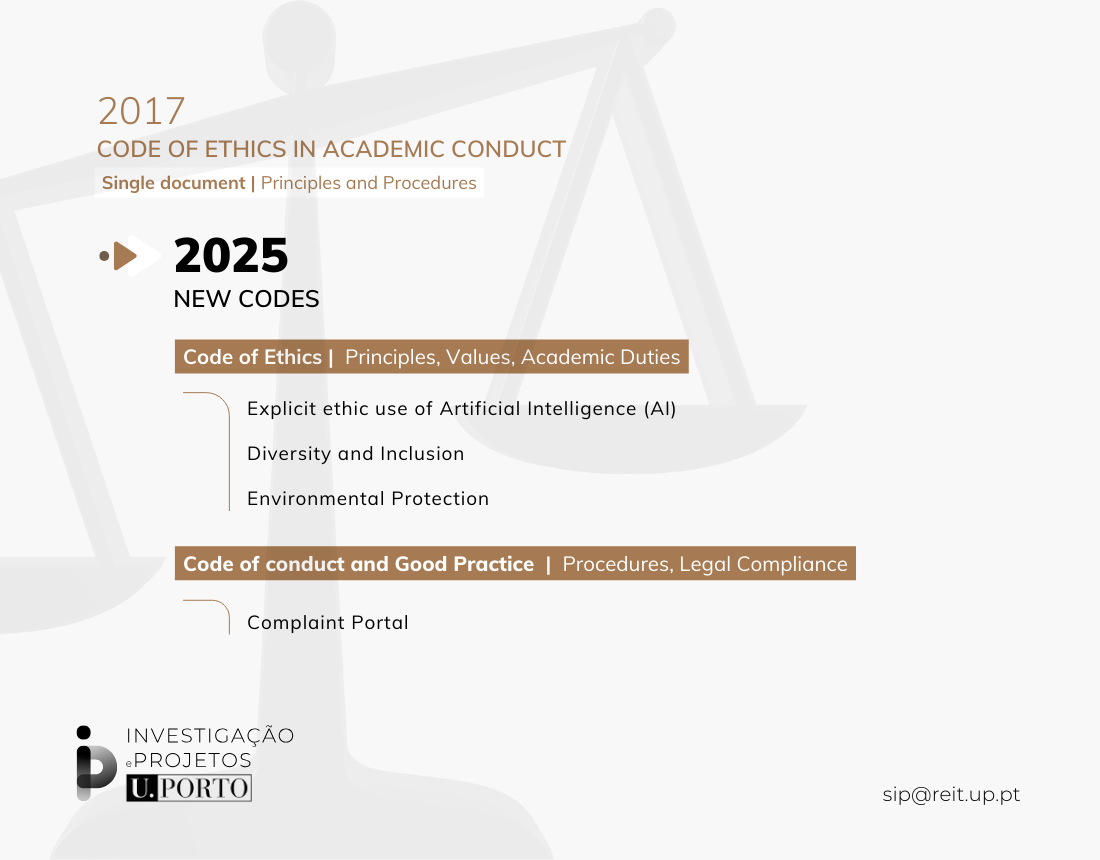
In 2017, the University of Porto approved the Code of Ethics in Academic Conduct (CECA), a single document bringing together ethical principles and procedures for the entire academic community. In 2025, the code was updated and divided into two complementary documents that revise its ethical framework and enable a clearer and more specialised approach:
University of Porto Code of Ethics: focused on academic principles, values and duties (integrity in research, teaching, and interpersonal relations). For the first time, it explicitly addresses the ethical use of Artificial Intelligence, establishing that AI is a tool which must not replace critical thinking or human authorship, but should be used and declared transparently. It reaffirms equity, diversity and inclusion as foundational values, reflecting the institution’s ongoing commitment to plural and respectful scientific environments. The new Code of Ethics also explicitly enshrines environmental protection and the responsible use of resources as fundamental principles in academic and research activities. Code of Conduct and Good Practice: centred on administrative procedures, the prevention of corruption, conflicts of interest and legal compliance. It also regulates a protected Complaint Portal for reporting irregularities and potential ethical violations, ensuring the confidentiality or anonymity of the whistleblower, as well as a risk management plan covering all areas of activity, including research.
This new two-document structure makes it possible to distinguish values and principles from procedures and control mechanisms, to develop each dimension in greater detail, and to strengthen a culture of integrity in a transversal and systemic manner.
|  |
The ethical governance of the University of Porto is based on an articulated and multi-level structure coordinated by the University of Porto Ethics Committee (CEUP). Established in July 2008, CEUP is one of the pillars of this strengthened ethical governance. It is the body responsible for monitoring and promoting standards of integrity, honesty and ethical quality at U.Porto. It meets in plenary on a monthly basis, brings together representatives from different scientific fields, and supports the local ethics committees of the faculties and research institutes.
The U.Porto ecosystem includes a network of Ethics Committees organised across different levels. This networked model fosters a structured and active proximity-based approach to ethics, allowing the specific scientific characteristics of each field to be taken into account, ensuring coherent institutional coordination, providing timely and well-informed responses to emerging ethical issues, and continuously reinforcing a culture of integrity in research and teaching:
CEUP (central level): receives requests for ethical opinions on research projects, particularly those involving sensitive matters (human participants, animals, biological material, personal data), as well as general ethical issues. It also supports the local committees. Ethics Committees of the Organic Units (14 of the 15 faculties): of the 15 Teaching and Research Organic Units of U.Porto, 14 have their own ethics committee (ESEP, FADEUP, FBAUP, FCNAUP, FCUP, FDUP, FEP, FEUP, FFUP, FLUP, FMDUP, FMUP, FPCEUP, ICBAS). The Faculty of Architecture (FAUP) submits requests directly to CEUP. Ethics Committees of the Research Institutes: CIIMAR, i3S, INEGI, INESC TEC, ISPUP. Requests for opinions from CEUP must be submitted through the SIGARRA platform, where the relevant procedures and forms are available.
To submit a request for an opinion to CEUP, please consult the procedures and forms available here.
For additional information on the Ethics Committees of the Teaching and Research Organic Units, please access here. |
|
|
|
Copyright 2026 © Research and Projects Office of the University of Porto |
All rights reserved. | sip@reit.up.pt |
|
|
|
|
|